

When Postman Changed, Some Teams Had No Choice but to Leave
A look at the regulated developers who lost their API client overnight, and the opportunity that created



TL;DR
What changed: Postman went cloud-first and enterprise-focused, quietly breaking its original promise of local, offline API testing.
Who still needs this: Compliance-sensitive backend teams in fintech, healthcare, and regulated enterprises that can’t send requests, payloads, or secrets to the cloud.
What to build: A focused, offline desktop API client that just tests APIs safely — no accounts, no sync, no noise.
What Opened the Door
Postman didn’t fail.
It succeeded at becoming something else.
What started as a lightweight, local-first API client slowly transformed into a cloud-centric “API platform”: workspaces, sync, collaboration layers, governance, AI, monetization, enterprise contracts.
That’s a perfectly valid business strategy.
But in the process, Postman quietly broke a critical promise:
“You can safely test APIs on your own machine.”
For a large and very specific group of developers, that promise wasn’t a convenience. It was a requirement.
Postman didn’t wake up one day and decide to abandon developers. It followed a very familiar SaaS arc.
Cloud sync became the default. Accounts became mandatory. The product expanded to serve managers, security teams, and procurement. Not just the person sending the request.
That shift came with higher pricing, heavier workflows, and a growing assumption that every user would be online, authenticated, and synced.
For many teams, that difference was tolerable friction.
For regulated teams, it was a hard stop.
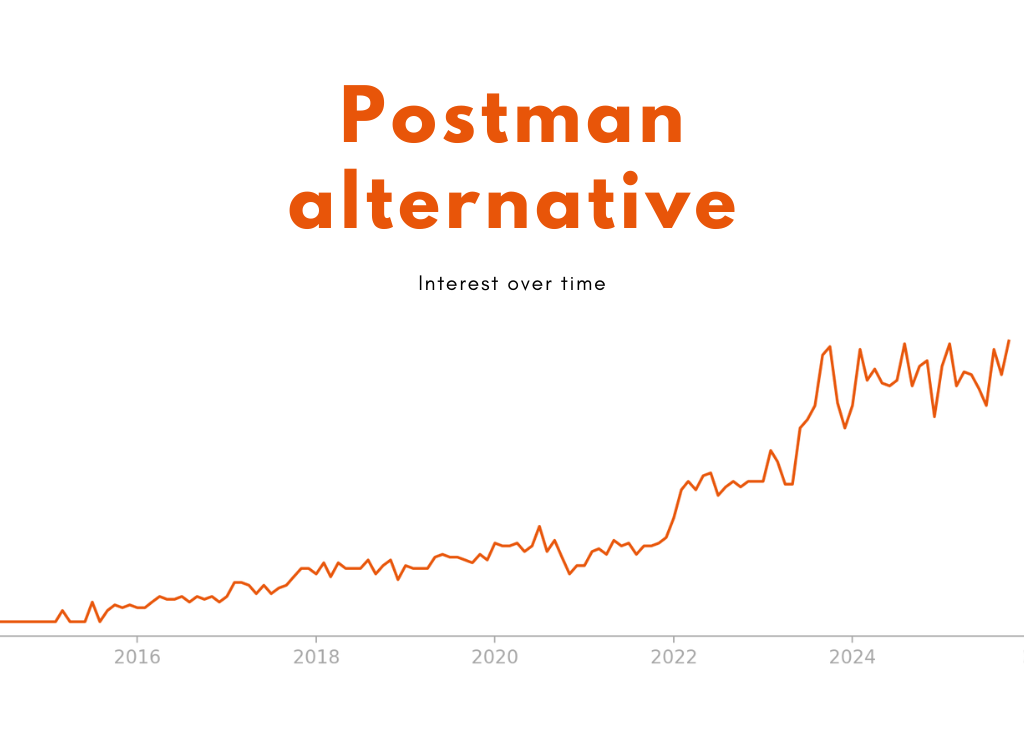
When Postman removed offline Scratchpad and forced cloud accounts and sync, those teams didn’t complain, they were forced out.
That incompatibility opened the door for something calmer, focused, and under control.
Who Got Left Behind
Picture a backend engineer working on internal APIs at a fintech or healthcare company.
Their job isn’t to explore public endpoints or collaborate in shared workspaces. It’s to test private services that move sensitive data between internal systems. Requests often include real identifiers. Environment variables point at staging or production infrastructure. Nothing here is disposable.
Their workflow is repetitive and practical: send a request, inspect the response, tweak a header, run it again. Save a few calls. Switch environments. Move on.
When Postman became cloud-mandatory, that workflow broke.
Security flagged the tool. Syncing requests was no longer acceptable. Accounts were no longer optional. The engineer didn’t debate UX or pricing, they were told to stop using it.
So they adapted.
They duct-taped solutions together. A mix of cURL scripts, editor plugins, half-supported alternatives. Some lost features they relied on. Others accepted slower setups or missing capabilities just to stay compliant.
None of these tools felt right.
What they wanted was boring: something that just works, stays local, and doesn’t require justification.
They would happily pay for that calm.
Where Indie Wins
Big platforms win by expanding.
Indie tools win by refusing to.
This niche doesn’t need more features. It needs fewer assumptions.
A focused indie product can make choices that large platforms can’t easily reverse. No accounts. No background sync. No roadmap pressure to add collaboration layers. No need to justify every decision to enterprise buyers.
That restraint becomes the advantage.
Where large tools become slower, heavier, and harder to approve, a small tool can feel obvious. Fast to install. Clear in scope. Owned by the user.
Once you see it, the outcome feels inevitable.
Of course a calm, local-first tool would win here.
How to Build the MVP
Must-have Features
Offline-first by default
The app must work fully offline from first launch, with no accounts, logins, or background sync. This guarantees requests, payloads, and secrets never leave the machine, making the tool immediately approvable by security teams.
Fast request creation and execution
Users should be able to create, send, and iterate on HTTP requests in seconds. The experience should feel closer to a local CLI than a SaaS dashboard — minimal friction, instant feedback.
Clear response inspection
Responses must be easy to read and trust: status, headers, and body presented cleanly, with sensible formatting for JSON and text. The goal is quick understanding, not analytics.
Local collections and environments
Requests, folders, and environment variables are stored directly on disk as files, not hidden in a cloud workspace. This makes the tool Git-friendly, auditable, and easy to back up or share internally.
Postman import for zero-friction switching
Existing Postman collections can be imported so teams don’t lose prior work. This isn’t about full parity — it’s about removing the psychological and operational cost of switching.
If a new user can download the app and send a real request within fifteen minutes — without touching the internet — the MVP is doing its job.
For Developers
Desktop shell: Electron or Tauri — both allow shipping a true offline desktop app with full filesystem access; Electron optimizes for JavaScript speed-to-market, while Tauri optimizes for smaller binaries and lower memory usage.
Frontend: React or Svelte — ideal for fast iteration on form-heavy UIs; both handle state-driven request editors and responsive response viewers cleanly.
Styling: Tailwind CSS — enables a clean, utilitarian interface without design overhead, well suited for a calm, editor-like developer experience.
Backend (local): Node.js + SQLite — no server required; requests, history, and environments live locally, satisfying compliance, auditability, and offline constraints.
HTTP client: Axios or native Fetch — mature, predictable request handling with precise control over headers, timeouts, and retries.
Distribution: GitHub Releases — simple, trusted binary distribution and updates without introducing SaaS infrastructure.
This stack minimizes boilerplate, avoids cloud dependencies entirely, and maps directly to the core constraint of the niche: local-first, fast, and approvable.
For No-Coders / Light MVP
This path is about validating demand and messaging, not shipping the final compliance-grade product. A non-technical founder can get signal in days.
Frontend prototype: Bubble — create a simple interface that mimics the core flow: define a request, send it, and inspect the response. Use Bubble’s API Connector to call real endpoints and display status, headers, and body. Focus on the feel of the workflow, not completeness.
Local-ish data simulation: Airtable — store sample requests, environments, and variables as records. This approximates collections and lets you test how users think about organizing requests without building file-based storage yet.
Logic & glue: Make — connect the UI to APIs, log responses, and simulate retries or errors. This helps validate which interactions matter most to users before writing any real infrastructure.
Landing + waitlist: Webflow — publish a clean, credible landing page explaining the offline-first promise and the problem with cloud-mandatory tools. Pair it with a simple email capture to test willingness to engage.
Email capture & follow-up: ConvertKit — collect emails, send a short validation sequence, and invite early users to interviews. This helps confirm urgency and pricing expectations quickly.
This setup won’t pass a security review — and that’s fine. Its job is to prove that the niche exists, that the pain resonates, and that people are willing to pay. Once validated, the real product should move to the developer stack above.
Builder Prompt Toolkit
UI Prompt
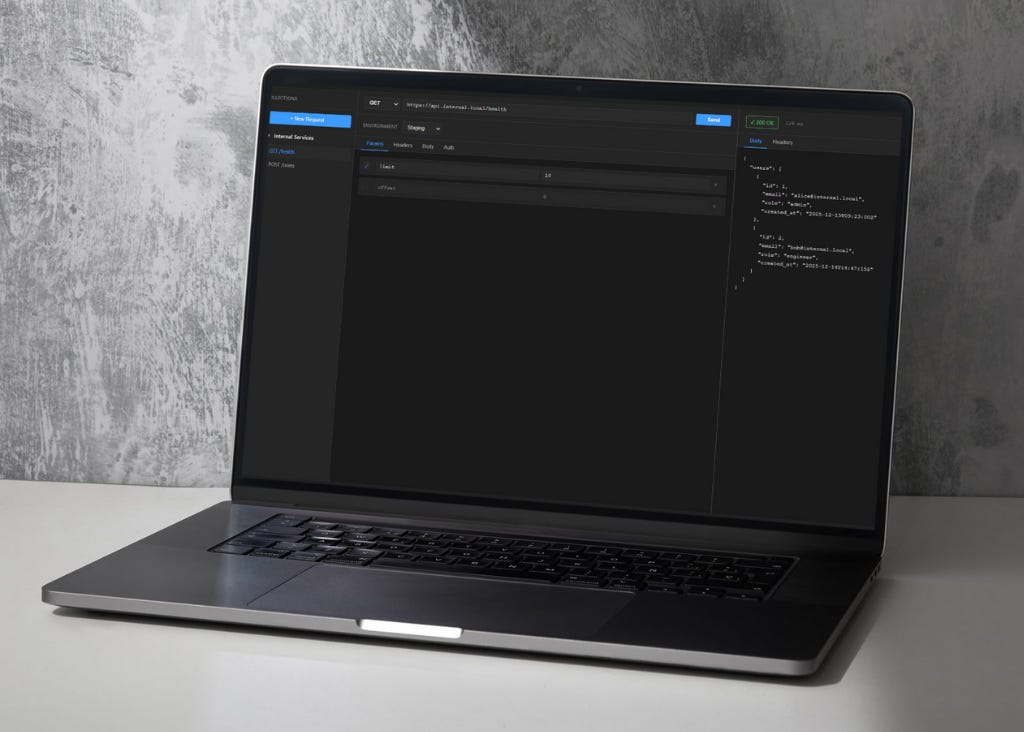
Design a desktop-first API client specifically for compliance-sensitive backend engineers working with private internal APIs. The product should feel calm, fast, and predictable, with zero visual noise. The primary layout consists of a left sidebar showing local collections and folders stored on disk, a central request editor where users can define method, URL, headers, query params, and body, and a right or bottom response panel that displays status code, response time, headers, and formatted body. The interface should prioritize keyboard usage, fast switching between requests and environments, and instant feedback when sending requests. Environment variables should be clearly visible and editable, with strong visual separation between environments like local, staging, and production to avoid mistakes. There should be no collaboration features, no user accounts, no cloud indicators, and no marketing surfaces. Visual style should be utilitarian and editor-like, inspired by early Postman, VS Code, and terminal tools, using neutral colors, clear typography, and restrained spacing. The emotional tone should communicate control, safety, and trust. This design is for a solo founder without a designer, so it should rely on simple, reusable components, consistent spacing, and a minimal design system that can be implemented quickly without custom illustrations or complex animations.
Landing Page Prompt
Write a builder-first landing page for a fully offline, local-first API client designed for compliance-sensitive backend teams. The page should immediately surface the core pain: modern API tools quietly forcing cloud sync, accounts, and loss of control. Open with a strong headline that contrasts “cloud-first” versus “local by default” and makes it clear this tool exists because Postman stopped working for regulated environments. The subheadline should reassure the reader that this tool keeps requests, payloads, and secrets on their machine — by design, not by policy.
Structure the page to feel calm and credible, not salesy. Clearly explain what the tool does in simple language: send requests, inspect responses, manage environments, all offline. Highlight benefits like compliance safety, zero setup friction, no accounts, and fast local workflows. Include a short founder story explaining why this product exists — a practical response to tools becoming bloated and unapprovable. Close with a single, low-pressure call to action to join a waitlist or early access list, framed as joining a quiet alternative rather than booking a demo. The tone should be indie, direct, and confident, focused on trust, clarity, and control rather than hype.
Validation Email (copy & paste)
Hey {{First name}},
Quick question — how are you testing internal APIs these days?
We keep hearing from backend teams that once Postman went cloud-first, it became hard (or impossible) to use for regulated environments. Syncing requests and environments outside the network just isn’t an option anymore, even for simple testing.
Some teams are stitching together cURL scripts, editor plugins, or half-working tools just to stay compliant. It works, but it’s slower and messier than it should be.
I’m exploring a fully offline, local-first API client built specifically for teams that can’t send data to the cloud. No accounts, no sync, just something calm that passes security review.
Would love to hear how you’re handling this today — and whether this would even be useful.
Take Action Today
Talk to five backend engineers who work in regulated environments and ask what replaced Postman for them.
Build the smallest possible offline prototype and see if it passes a basic security review.
Share what you’re building publicly and invite others who feel the same friction.